



There’s a Cuban coffee shack near the historic seaport in Key West that’s been owned by not one, but two of my ex-boyfriends—neither of whom happens to be Cuban. For added intrigue, the “Welcome to Key West” mural on its façade in the fashion of a 1950s vintage postcard was painted by one of those exes’ other girlfriends. And, come to think of it, a former lover also worked there for a time when fishing charters were slow and he needed extra cash. That tangled web is as typical of Key West as the roosters that crow in Bahama Village at dawn; this one just happens to be mine.
When the shop opened in 2009, it was all the rage among those of us who worked on the water. Its promise to happily deliver an order as small as a single café con leche anywhere in Old Town was a service much appreciated by the hard-partying, yet early rising and eternally youthful boat people I surrounded myself with. We were busy at the marina checking engine rooms, icing kegs, and pulling snorkel gear, preparing to hustle tourists by the hundreds on and off our boats for 12 hours straight. The coffee shack also made a great breakfast sandwich pressed between crusty Cuban toast with egg, melted cheese and sausage, which was the perfect fuel to start the day.
And every so often, the very nice man who opened the place, who was my boyfriend for a time, would hand deliver a smoothie to me at the marina between my parasailing excursions out to the channel. It just so happened that the handsome South African man driving the boat, my captain, would go on to buy the coffee shop from him a couple of years later and also become the greatest heartbreak of my life. But when our love affair was fresh and good, I’d tease him about my merchandise from the shop. “Oh no,” I’d say, “that mug was from the very nice man, not you.”
I moved to Key West at age 25. Having started my career in New York City as a public school teacher, I had decided that I wanted a little more adventure out of my young life. One night, shortly after moving to town, a new friend and fellow crew member, a cute guy with dirty blonde hair, whose nickname also happened to be Dirty, told me over beers: “In Key West, you don’t lose your girlfriend, you just lose your turn.” It struck me as particularly crass, and whenever I repeat this maxim to the uninitiated, their reaction is the same. But I would soon learn that crass humor was a way of life on the docks and come to embrace it. I’d also learn that there was plenty of truth in his assessment of the island’s insular mating rituals. My draw to Key West was the fantasy of a paradisiacal and lusty life aquatic—a Neverland filled with Lost Boys in red board shorts—that, at the time, I had only begun to realize I’d been pining for since my family left coastal Southern California when I was 13 for the landlocked, conservative South.
The very nice man and his chef business partner were gringos from the northeast and longtime Key Westers, kiteboarders who had traveled throughout Latin America, always returning to a windswept beach in Ecuador for the sport. They had created a fictional backstory for their Cuban coffee shack to lend it an air of authenticity, plus an aphorism emblazoned on mugs and t-shirts that felt particularly apt to how we existed in Key West: “Once your reputation is ruined, you can live quite freely.” When my South African boat captain bought the shop, he had an accountant business partner, a third generation “conch” (the term used to describe someone born in Key West) of Cuban descent, whose creative contribution to the menu was the Cuban bagel, essentially cream cheese pressed between Cuban toast, drizzled with honey and dusted with everything bagel mix. Nothing about this coffee shack is entirely authentic, yet it’s emblematic of Key West’s motley residents and remains an incredibly popular local business.
But the people of Key West were drinking Cuban coffee long before the very nice man opened his coffee shack by the seaport. We’d go to humble delis, grocers, and sandwich counters near the marina and around Old Town, the longest standing being Sandy’s Café, a traditional ventanita, or “little window,” next to a laundromat on White Street. Operated by the Santiago family since 1954, their “original Cuban sandwich,” painted on a sign next to the counter, is almost impossible to resist once you’ve reached the register. Pressed between Cuban bread, it’s made in what many consider “Tampa-style” with the addition of salami and mayonnaise (the simpler version popular in Miami only has ham, pork, Swiss cheese, pickles, and mustard).
There’s 5 Brothers, established in 1978, where you can pair your café con leche with the island’s best conch fritters on a quiet corner on Southard Street shaded by royal poinciana trees. And across the narrow Cow Key Channel on Stock Island, home to Key West’s last working waterfront, El Mocho is where commercial fishermen have gathered for breakfast at dawn since 1983. Here, the freshly fried croquetas jamon are crispy on the outside, silky on the inside and practically melt in your mouth.
For authentic Cuban food beyond the lunch counter, every local knows that off-the-beaten-path El Siboney, founded in 1984—and not the Cuban restaurant in the tourist crush of Mallory Square—is where you go for the best ropa vieja, picadillo, or, my favorite, garlic shrimp served with a heaping pile of yellow rice, brothy black beans, and stewed sweet plantains. In fact, it was the South African boat captain who first introduced me to El Siboney within a month of landing on the island.
And while it has changed hands a few times over the years, Key West’s oldest restaurant, Pepe’s, was founded in 1909 by a Cuban fisherman. Today, the bartender on the patio will freshly squeeze an orange before your eyes to accompany your vodka at brunch; the most miraculous screwdriver you’ve ever tasted.
My Cuban coffee spot was the Courthouse Deli on the corner of Whitehead Street, where I’d tumble off my beat up red bicycle on my way to the marina from my little conch cottage in Bahama Village and order a con leche. In Key West, we drop the “café” from café con leche, an order that, after I moved to Miami, I realized confused Spanish-speaking baristas—“Con leche? Milk with what?”—and swiftly reverted to ordering the beverage by its full name.
At the Courthouse Deli, I learned to ask for my small con leche with just half a sugar. Made with strong, finely ground, dark roast espresso, the powerful bitterness of Cuban coffee is balanced with a crown of espuma, a frothy foam made by whipping a small amount of coffee with sugar. In the case of café con leche, that intensity is further mellowed with steamed milk, like a latte, and as many heaping spoonfuls of sugar as you like for a drink that’s sometimes so sweet it hurts your teeth. Half a spoonful was enough for me. You could also get your Cuban coffee as a high-octane, single shot of cafecito (called a bucci in Key West and nowhere else I’ve ever seen); a cortado or cortadito, a shot of espresso “cut” with a splash of steamed milk, similar to a macchiato; or a colada, a larger portion of the sweetened espresso, typically served in a Styrofoam cup with a small stack of thimble-sized plastic cups meant for sharing.
I drank my con leche with half a sugar for at least a year straight after moving to Key West, reveling in the espresso’s rich, powerful sweetness and soothing steamed milk for a morning ritual that was pure pleasure—until one day my palate must have hit its limit because, quite suddenly, the sweet, highly caffeinated beverage felt cloying and stale in my belly. I switched back to the very American, black drip coffee that my mother drank and her mother before that.
Key West is famously closer to Cuba – at 90 miles due south across the warm, swiftly moving Gulf Stream current – than mainland Florida. The drive up the Overseas Highway to Miami is 165 miles. The relationship between the two islands dates back to Key West’s origins in the 1820s and remained enmeshed throughout the 19th century as Cuba fought for independence from Spain, finding both refuge and an ally in Key West. The cigar industry moved from Havana to Key West during the Ten Years War, starting in 1868, and, for a time, roughly half of Key West’s population was of Cuban descent. In 1886, a great fire devastated much of this industry and it moved to Tampa along with a sizable segment of the Cuban population. But it was in Key West in 1892 that Cuban nationalist hero José Martí united the exile community and launched the final phase of Cuba’s campaign for independence, which was eventually achieved in 1902. The two islands enjoyed regular commerce and ferry service up until the late 1950s when Fidel Castro and his Communist regime rose to power.
Today, only about 12 percent of Key West’s roughly 26,000 residents are of Cuban heritage and 60 percent are white. So while the Cuban culture is deeply embedded in Key West’s history, food, and coffee, my fellow crew members drinking con leches on the docks were not Cuban, but mostly Midwesterners. If my friends from Key West had Cuban heritage, it tended to go back generations, and their cultural assimilation was more particular to the idiosyncrasies of Key West than the broader American culture.
One of the most recognizable pipelines to Key West that I observed during my time on the island came via a small town in Indiana and, particularly, one of my best friends who hails from there. Since his arrival in Key West, a steady stream of young men and women from his town have landed on the island to work on the water for a few years before returning to Indiana to start their lives, as if it were the Peace Corps. When my friend first arrived, he attempted to sail to Cuba without any nautical skills, but didn’t make it very far when his small boat’s rudder snapped and the Coast Guard came to his rescue. He’s been a fully licensed boat captain in Key West for almost 20 years now.
I left Key West in 2010 a few months before my 30th birthday, driving three and a half hours up the Overseas Highway to Miami. It felt like the right time to forgo the pursuit of never growing up and return to the real world. “So you moved to South Beach?” was the incredulous response I got from an acquaintance early on. But, for me, Miami’s sultry aquamarine beaches dotted with glamorous hotels and debaucherous nightclubs was just the right amount of reality to ease me back into mainland life. Generally speaking, Key Westers tend to find Miami too flashy and Miamians fail to grasp the offbeat charms of Key West, but both places absolutely delight me. While my appetite for Cuban coffee and food was mostly sated during my years in Key West, in Miami I was becoming friends with people who hailed from Latin America due to more contemporary waves of immigration.
Miami’s demographic is practically the inverse of Key West’s, with 69 percent Hispanic population, and only 13 percent of its residents white and/or non-Hispanic. More than half its residents are foreign-born and 75 percent are bilingual, many with English as their second language. You hear Spanish spoken on the streets nearly as often as you do English. Many of my contemporaries were first-generation Cuban Americans, whose parents and grandparents had escaped Castro in the 1950s and 60s. Other friends hailed from Colombia, Venezuela, Nicaragua, and elsewhere in Latin America to escape the oppressive regimes in their native countries. They had immigrated to Miami anywhere from infancy to their teenage years. I dated Latin men and received a new kind of cultural immersion beyond just coffee and food.
As a burgeoning travel writer and journalist who worked from home, I also made my coffee at home, but my strongest memory of coffee in Miami also involves a man and cafecito. One afternoon, I visited Versailles, the famed Cuban restaurant on Calle Ocho in Little Havana that has been an institution since 1971. I was there on a reporting assignment to learn about the history of the medianoche, the diminutive Cuban sandwich pressed on sweet, brioche-like egg bread, instead of crusty Cuban toast, which became a popular midnight snack (hence the name) in Havana cafeterias after the nightclubs closed. The secret to the medianoche at Versailles is the “double press.” Before the bread is swept with butter and the whole sandwich is pressed together, it receives an open-faced press for 15 seconds to crisp the ham and bring out the sweetness of its honey glaze. After a sandwich demo and interview with third generation owner Nicole Valls, I left the restaurant with the finished product wrapped up to go.
I was on my way to see a strapping Bolivian man I was crazy about at his condo in Edgewater for a conversation I dreaded. I planned to give him the medianoche. Although I was raised in a Reform Jewish household and never kept Kosher, there was something about so much pork concentrated into one dish that never allowed me to fully enjoy the obvious pleasures of the Cuban sandwich. I wanted my own treat from Versailles, something sweet and comforting, before this conversation that would likely determine the fate of my relationship with this man. I stopped at the ventanita for a cortadito. The Styrofoam cup’s plastic lid opened to reveal a swirl of caramel-colored espuma and milk froth that tasted more like the torched crust of a crème brûlée than mere coffee. It was the most delicious cortadito I’ve ever had. After that evening, standing with that man on his balcony as the sun set over Biscayne Bay, we would continue to break up and come back together again and again, a cycle we still haven’t completely gotten out of our systems.
Years later, after I’d moved back to New York, he and I would find ourselves strolling down Calle Ocho one afternoon, catching up, and I would wax poetic about the Versailles cortadito without fully realizing the context of that most memorable cup of coffee. Not quite convinced by my crème brûlée metaphor, he would laugh and smile at me in his familiar manner that always felt like love and say, teasingly, “You must be a travel writer.”
Now that I’ve been back in New York for a few years, I crave the Cuban coffee in Miami in a way I never did when I lived there. It’s kind of like how I never appreciated Southern comfort food or country music when I lived in the South, but now I thrill at the sight of fried green tomatoes on a menu and love singing along to country music at the top of my lungs whenever I’m driving down a long and winding road alone. These sense-memories recall a specific time and place in life—who you were and the people you loved—that you couldn’t otherwise retrieve so viscerally.
A few weeks ago, in an Uber on my way to the Miami airport, flying back to New York, I got to talking about Cuban coffee with my driver. He was from Cuba and told me he had lived in Miami “long enough” to know he was ready to live somewhere else. “I miss it,” I told him, bringing up Versailles. “You can’t find Cuban coffee in New York the way you do in Miami.” He was indifferent to my romantic notions. “Just go to one of the many Italian restaurants in New York and ask for an espresso with lots of sugar,” he said. I laughed. “Oh, I do that,” I assured him. “But it’s not the same.”
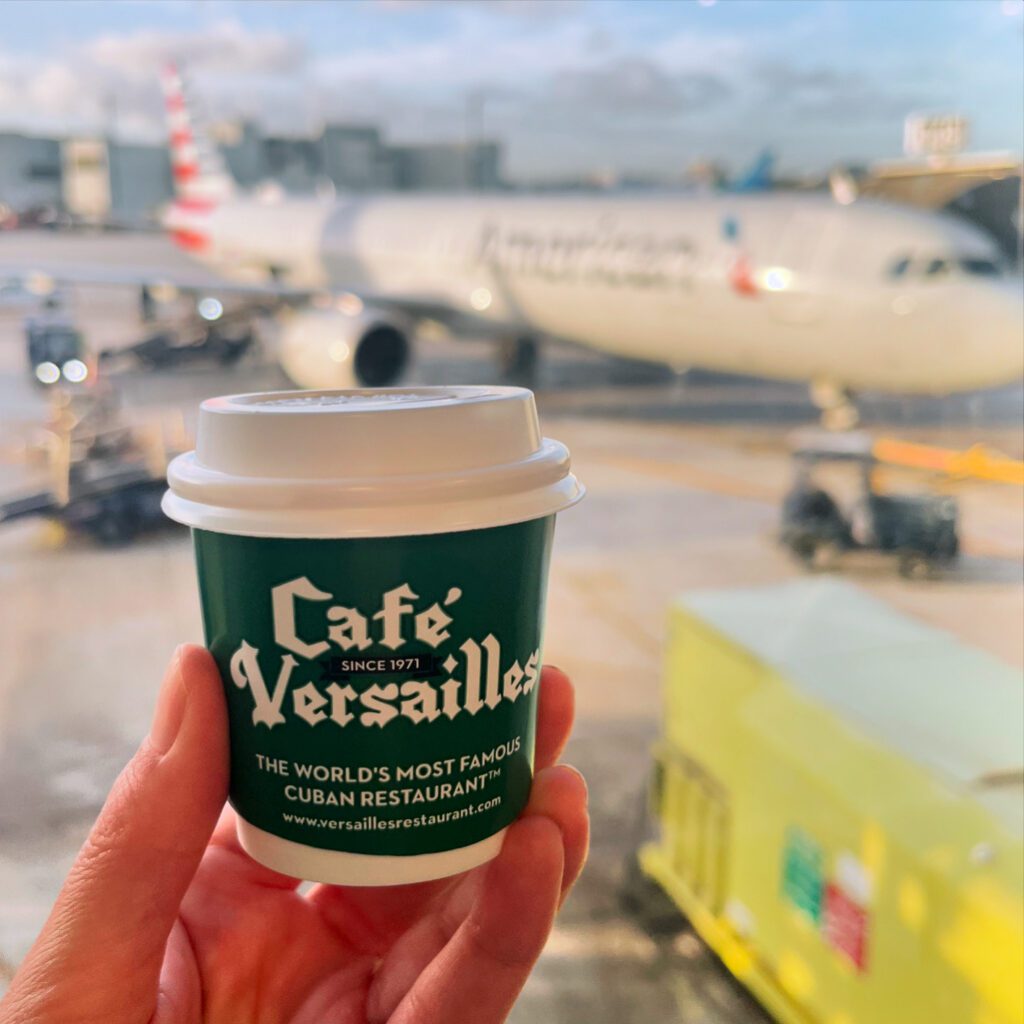
When I got to the terminal, I went straight to the Versailles counter and ordered a cortadito, something I rarely did during the near-decade I lived in Miami, jetting in and out of that airport two or three times a month, usually to destinations in the Caribbean and Latin America on assignment. And now, whenever I’m back in Key West, I’ve begun patronizing that Cuban coffee shack by the seaport again. Although it conjures a memory, the coffee never tastes quite as sweet.
A version of this essay originally appeared in Drift. Illustration at top by Naomi Ann Clarke for Drift

